Making Songs

Singing the Land: Finding Connection through Song

by Rebecca Hass November 10, 2025.

In the last year I have had so many incredible opportunities to be in the space of composing music. It was never in my mind that this would be part of my practice as a creative being. I have had so much encouragement, and I have found such great joy in welcoming the melodies that come to visit. I keep trying to find a way to express my journey in words, and my vision. Here is what it feels like today.

When I was little, people in my small Ontario town knew me as the girl who sang all the way to school and back. At home, I was the star of our kitchen parties—singing folk and country songs while my uncle played the spoons and my grannie step danced. Looking back, I realize that was my first lesson in what music can really do: bring people together.

Over the years, my path took me far from those early roots. I spent decades as a classical mezzo-soprano, performing on big stages across Canada and abroad. I lived almost entirely inside the world of my European ancestors—German, English, and French—where music was complex, intellectual, and carefully constructed. It was beautiful, but something in me was still searching for a deeper kind of connection.

It’s only in the last few years that I’ve begun to bring all of myself into my creative work, including my Georgian Bay Métis ancestry and the teachings passed down from my dad and my grannie. This has completely changed how I think about music—why I make it, who it’s for, and what it can do.


Learning to Value “Simple” Again

My classical training taught me that “complicated” meant “better”, but in the years I have sat and drummed with my urban Indigenous community, I have reconnected to my ancestral understanding of music. Elders and knowledge keepers have helped me remember that a song’s power is in its ability to be shared. A song that’s easy to learn and sing together opens our hearts and spirits. It allows everyone in the circle to feel the rhythm, the words, and the story—not from the head, but from the heart. The songs that I was singing in urban Indigenous community were inviting people in, and I realized, that is what I wanted to do with my music too. 


Listening for the Songs in the Land

When I’m out walking—on city trails, by the ocean, or in the woods—I often hear melodies. They arrive quietly, like little whispers. Sometimes they fade as quickly as they come. Other times, they stay with me, and I find myself humming them over and over. I’ll record them on my phone so they have a chance to grow into songs.

My Anishinaabe brother and Elder, René Meshake, taught me that the music is already in the land—you just have to listen for it. That idea changed everything for me. After more than thirty years of performing other composers’ music—studying every note, every phrase, every emotion, searching for perfection in my vocal instrument—I’ve come to a point in my life where I want to listen differently and sing differently.  


Why I Make Music Now

These days, I see music as a way to bring people back to themselves and to each other. As someone of mixed European and Métis heritage, I carry many musical languages inside me. My work now is about letting them meet—finding ways for different traditions, stories, and voices to sit together in harmony.

We live in a world that can feel divided, fast-paced, and disconnected from the natural world. But when we sing together—when we share breath and vibration—we remember something ancient and true. We remember that we belong.

Through my compositions and community gatherings, I hope to create spaces where people can reconnect with their own ancestors, with the land beneath them, and with the joy of making music together.


Looking Ahead

Composing in this new way feels both exciting and humbling. I’m still learning, still listening. Each new song feels like a small discovery—a thread that leads me toward deeper understanding.

After a lifetime of performing others’ work, I’m finally finding my own voice. And it’s rooted in something simple, yet profound: the belief that music has the power to heal, to gather, and to remind us of who we are.Sharing songs for me is a radical action. I know that when we sing together, and we sing the land, we become one once again with all our relatives. 
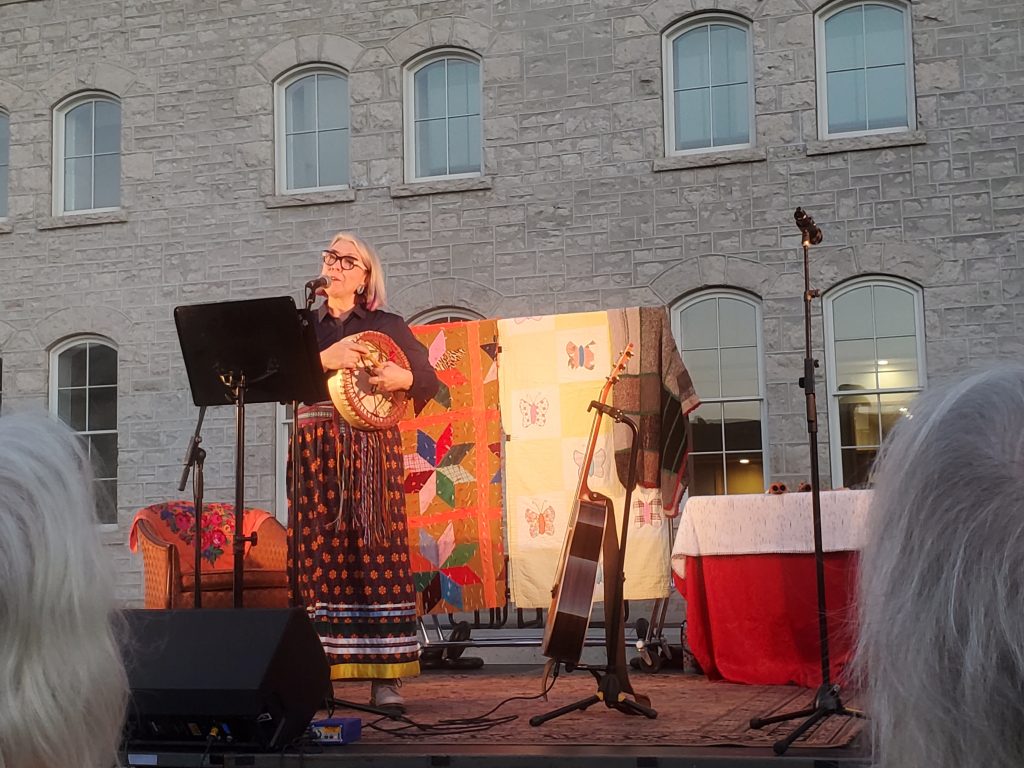
The Song Blanket-A Story Telling Concert

7 pm | September 30, 2025

Guelph City Hall

The Song Blanket is a work in development, ahead of its anticipated full premiere at New York’s Symphony Space in 2026. This special Guelph presentation offers a rare opportunity to experience the heart of the piece in an intimate setting, where personal story becomes collective reflection.

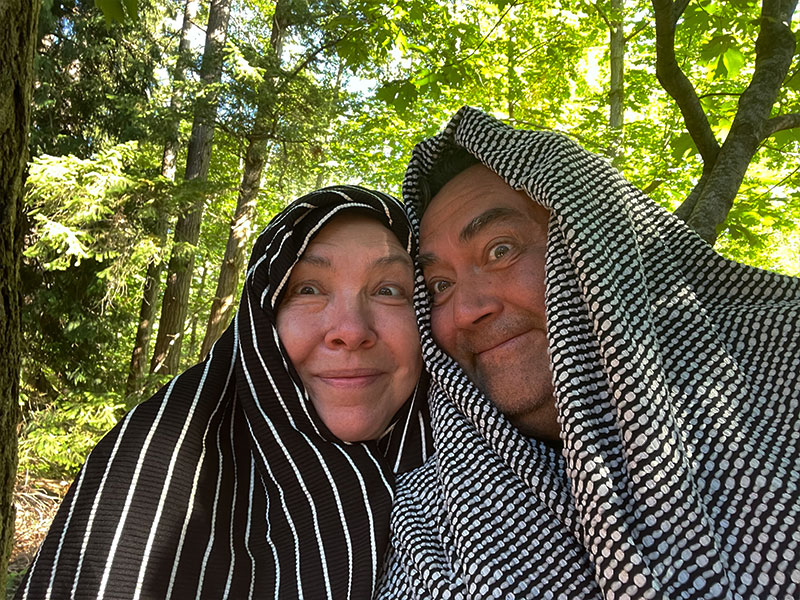
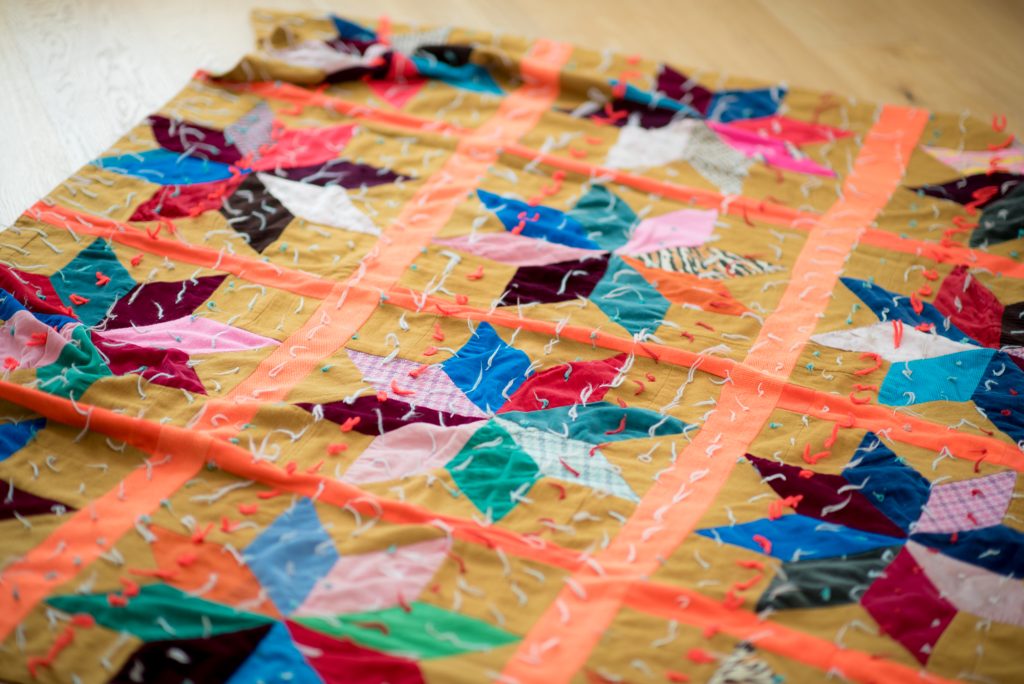
Blankets are more than warmth—they are memory, protection, and legacy. In The Song Blanket, Métis artist Rebecca Hass (Georgian Bay Métis, French, German, English) invites us into a deeply personal and powerful journey through story and song, woven from the threads of her family’s hidden history and the teachings passed down through her granny’s quilts.

This intimate performance honours the matriarchs—those who sewed, wove, and dreamed their love into every stitch. Drawing on traditional knowledge shared with her, Rebecca shares songs written for drum, guitar, and flute, activating “blood memory”—a connection to ancestors, known and unknown. Audiences are invited not only to witness, but to participate, learning a song that carries the teachings of the quilt home with them.

Join us as we gather on the National Day for Truth and Reconciliation to honour the enduring strength of Indigenous matriarchs.

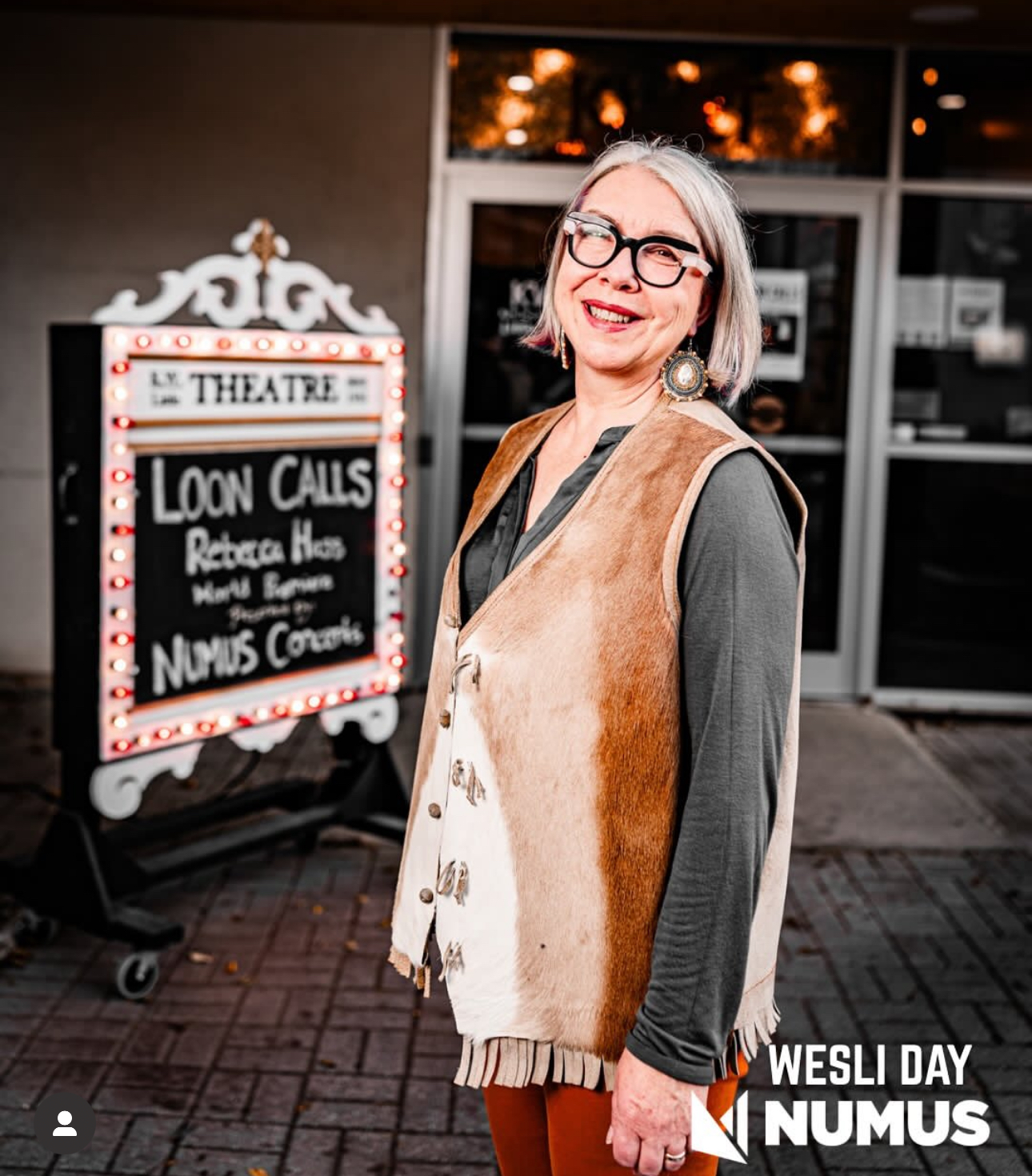
Loon Calls | NuMus Concerts 2025.26 Season

7:30 pm | Saturday September 27, 2025.

KW Little Theatre, Kitchener Waterloo, Ontario.


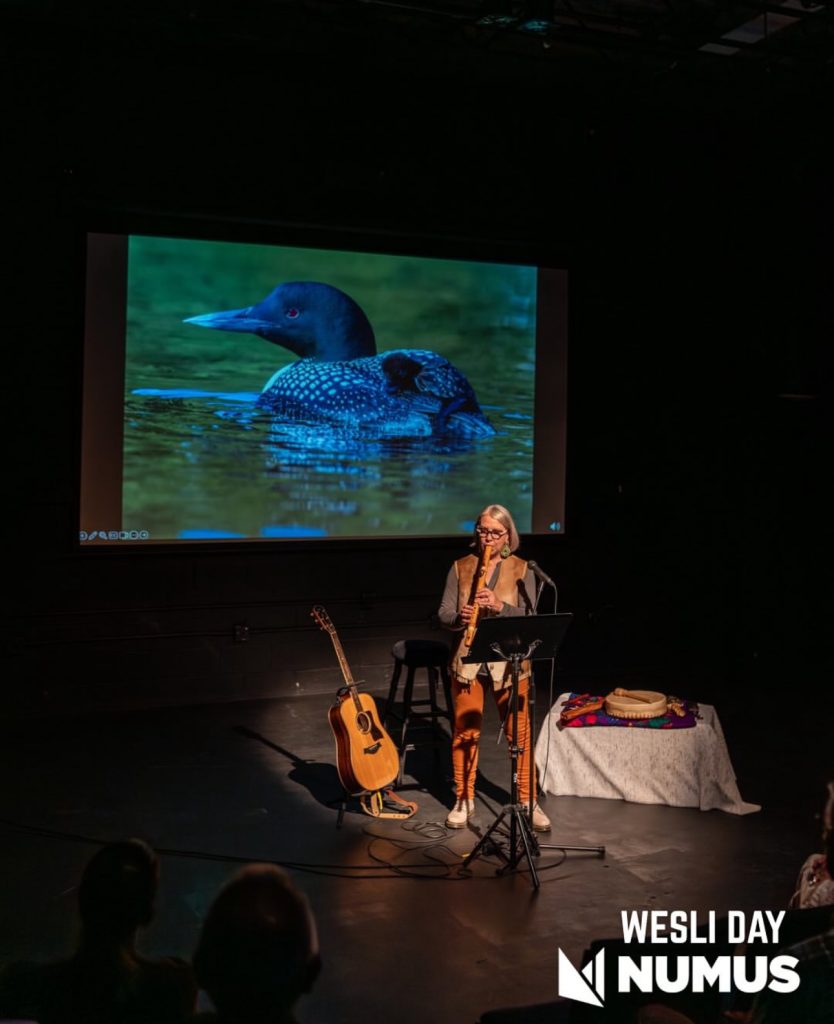
Loon Calls
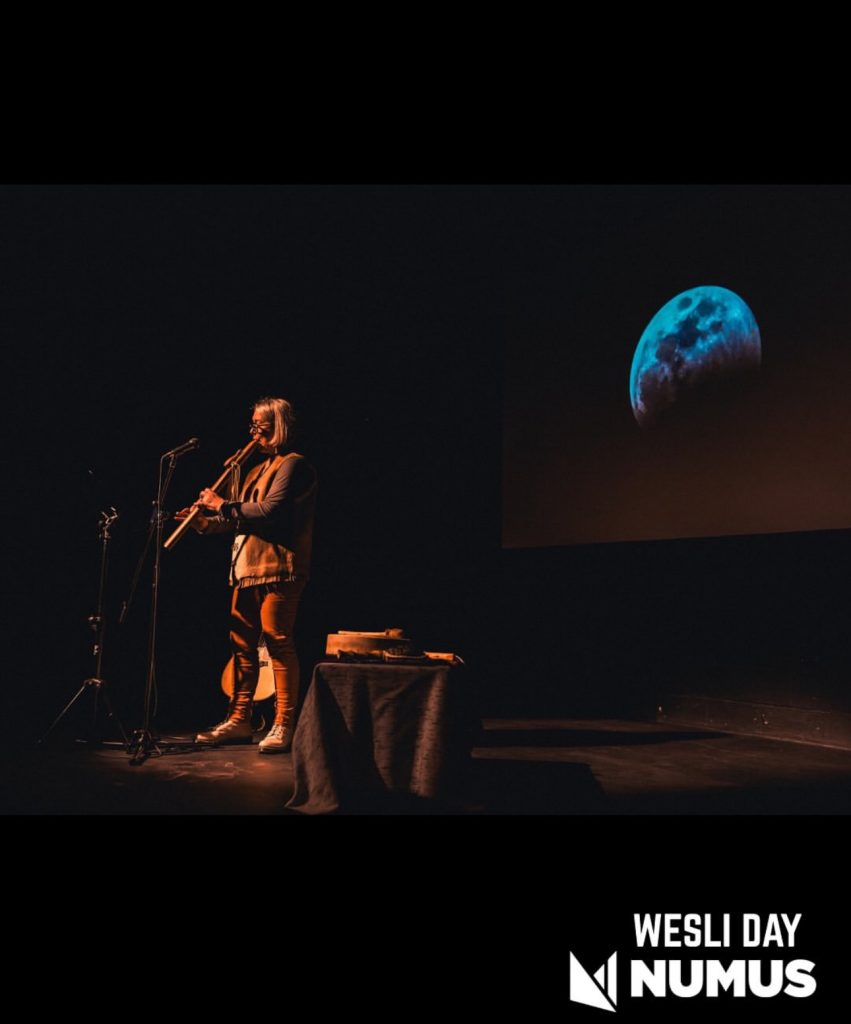
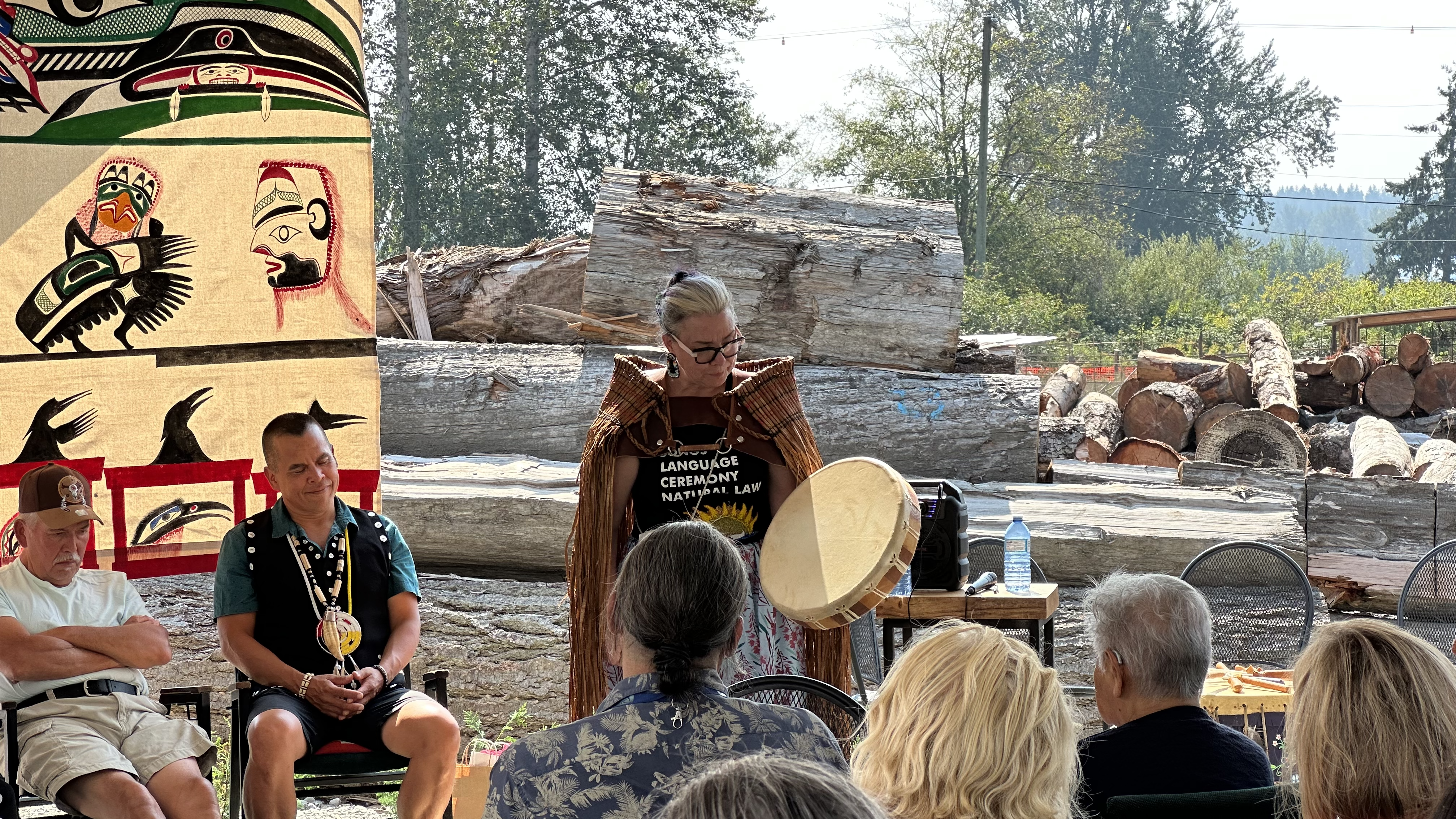
 is an immersive journey into the living language of the land, brought to life through music, story, and spoken word. Mezzo-soprano Rebecca Hass (Georgian Bay Métis, European) bridges her Western classical training with the heartbeat of the kitchen parties she grew up with and the drum circles she sings in today. Guided by a name given to her by Elders—Maanginoweh –“The voice of the loon on the lake”—Rebecca invites audiences into a shared space of listening, reflection, and reconnection.

At its heart, Loon Calls is about remembering that we are all connected. This sharing in gathering invites us to slow down and truly listen together. The land is still speaking: through the rhythm of the seasons, the pull of the moon, the quiet hum beneath our feet. Loon Calls helps us tune back in—reminding us that story, song, and vibration are pathways to belonging. As we move from disconnection to connection—with each other, with place, and with a broader national story—Loon Calls asks: Are we ready to listen? Are we ready to raise our voices, and sing with the land?

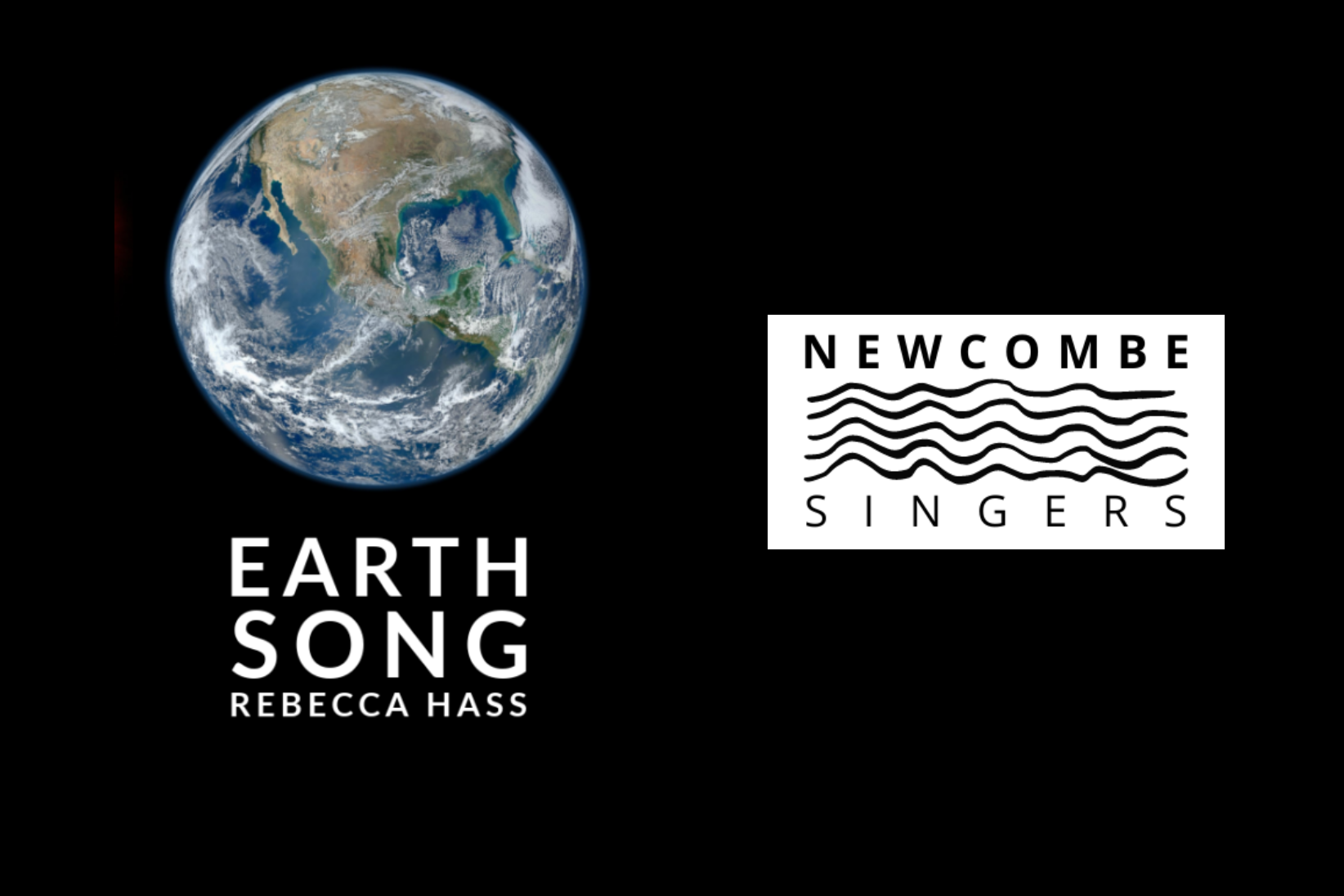
EARTH SONG

May 2, 3 2026 at 3 pm | The Newcombe Singers, Music Director, Kathryn Whitney

Earth Song is a concert co-curated by Kathryn Whitney and Rebecca Hass

Featuring a new choral composition premiere by Rebecca Hass

How shall we live well on the earth? First, we must ask the earth how it would like
to be lived upon. .
The concert EARTH SONG takes us on a journey, curated jointly by Métis singer
and composer Rebecca Hass and Newcombe music director, Kathryn Whitney, to a
place where we can hear the Earth sing.
Taking the idea of a Land Acknowledgment as our point of departure, our concert
mixes indigenous and non-indigenous voices, each of which, through singing,
brings us closer to the sounds of the natural world.
Listening to these voices, and lifting our voices to sing along with them, we hear
the earth and the sound of the tundra, trees, warm sun, and tall mountains. The
sound of our own footprint, as well as the history of the footprints of our own
ancestors on the land, becomes clearer, leading to understanding of our
relationship to the land, and to ourselves.
EARTH SONG offers our singers and audience the chance, through group singing,
to come to a new understanding of what it means to live on, and be part of, the
land.

You can learn more about this concert here

November 11, 2025 Reflection by Rebecca Hass

In the land acknowledgement that I often hear there is a line that strikes me ‘ we give our gratitude to the Indigenous people’s of this place who have stewarded it since time immemorial’. It’s that word: stewarded. That word leaps out at me. I am a visitor on the territory I live on, and I take caring for the land very seriously. I feel the responsibility to be a good caretaker, in relationship to, and in respect to, this land. I’m attentive to my own role as a visitor in being a good steward. This comes from how my Dad raised me, and the Métis teachings he carried from his mom. I grow medicine plants in my garden and have been working to restore my small yard to more of the Garry oak meadow it once was. I think about what I harvest, and from where, and think about how what I take might impact other creatures that also live on this land.

When Kathryn first spoke to me about working with the Newcombe Singers, it was my land based music creative practice that I wanted to share. I believe that we can all find ourselves and our role in the land acknowledgement. As visitors, we have a responsibility and an opportunity, to care for this place. The first step is to begin to listen more deeply to the place we are. To build a relationship to the land we are on.

If you were to stop and listen, what might you hear? Could you move beyond the sound of traffic, and the noise of city living? If you moved beyond the pavement, could you hear the lands tonality? Could you feel the beat of the ocean? Or the tempo of the forest at Beacon Hill?

I’m excited to begin this journey of listening and relationship building with this place with the Newcombe Singers. It is my vision to learn from the choir members what the land is telling them and let that lead into the choral composition for the May performance. What is it to sing the land? What is the song the earth is singing to us? I’m looking forward to exploring these questions and hearing the song that arises.

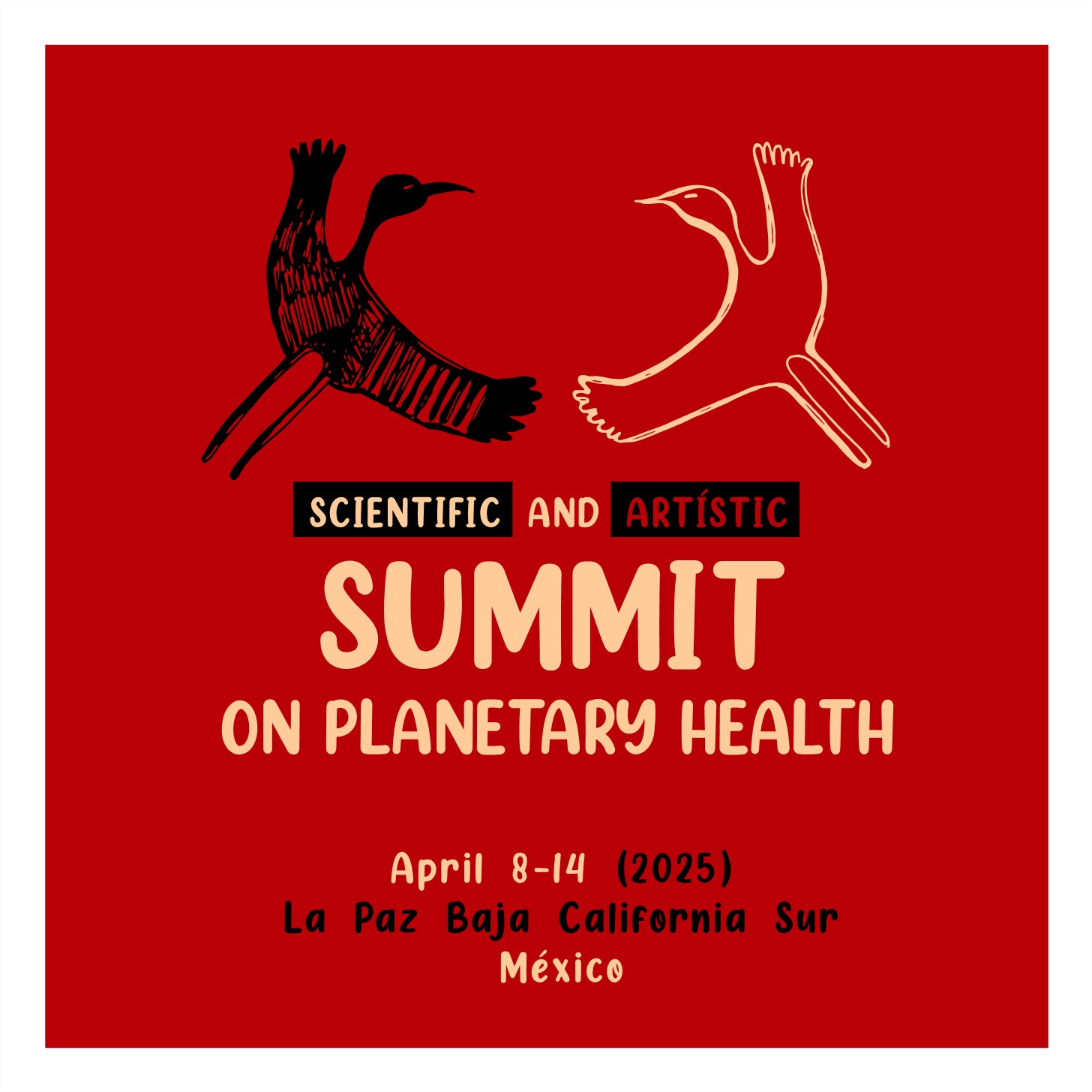
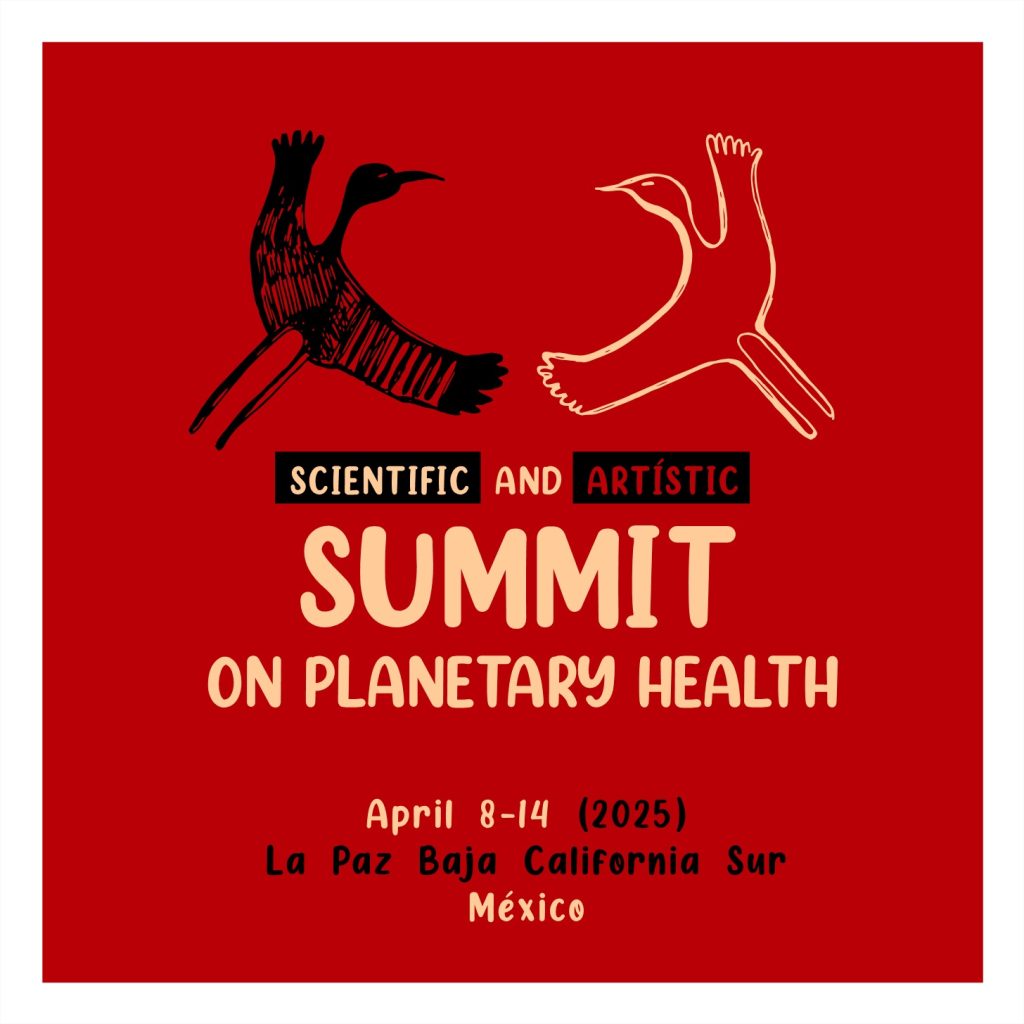
Scientific and Artistic Summit on Planetary

Scientific and Artistic Summit on Planetary

Global Pax Collective, artist team member

April 2025 and January 2026, Mexico City and La Paz Baja California Sur, Mexico

Communities of the Pacific West Coast (Mexico/Canada) for Climate Justice: Creating a shared agenda for planetary health and climate action. The project will be co-designed through existing partnerships and host gatherings in communities from Vancouver Island and Baja California Sur, Mexico working together to identify emerging priorities around climate justice and health equity in the Pacific West Coast region of North America.

Rebecca reflects: The initial journey in April of 2025 brought music to me through all my experiences. From the workshops where traditional knowledge was shared in community, to the sounds of the birds at dawn, to the shape of the horizon. When I returned to Victoria and began to process all these experiences, a song arrived that embodied the connection I felt to the people and the land in Mexico. The Connection Song can be sung in English, and in Spanish (with gratitude to Salma and her daughter Cali, for their translation work)

You can listen to the song here

Connection Song

Words and music conceived by Nitaawe Giizhigok/ Rebecca Hass

Inspired by the people, the land and the experience of Baja California Sur, Mexico

during the Artistic, Cultural and Scientific Planetary Health – April 2025.

Canción de conexión

Letra  y música por Nitaawe Giizhigok/Rebecca Hass durante su estancia en La Paz Baja California Sur en la Cumbre de Arte, Cultura y Ciencia por la Salud Planetaria (Abril-2025) – Traducción: Salma Yamel Alvarez.

Verse One

Can we see each other? 

Sing connection song,

Take away all borders?

Sing Connection song,

Soften our hearts?

Sing Connection song,

Hear ancestral voices?

Sing connection song.

Chorus: 

Way oh yah ha way oh yah ha

Si podemos vernos

Canta esta canción,

Quitamos fronteras.

Canción de conexión,

Suaves corazones.

Canta esta canción,

Voces ancestrales.

Canción de conexión.

Wey oh ya ja wey oh ya ja

Wey oh ya ja jey-

Wey oh ya ja wey oh ya ja

Wey oh ya ja jey-

Verse two

Can we hear the land? 

Sing connection song

Our relative, the land.

Sing connection song

Mother Earth’s song?

We can sing a long,

Hear her song,

Let’s sing connection song!

Chorus: 

Way oh yah ha way oh yah ha

Escucha a la Tierra

Canta esta canción,

la Tierra es familia

Canción de conexión,

Canción de Madre Tierra.

Podemos cantarle

Escucha su canción.

Canción de conexión.

Wey oh ya ja wey oh ya ja

Wey oh ya ja jey-

Wey oh ya ja wey oh ya ja

Wey oh ya ja jey-

Verse 3

Can we feel the wind?

Sing connection song,

Our relative the wind,

Sing connection song,

Carrying our voices,

Sing connection song

Ancestral voices,

They come and sing-a-long.

Chorus: 

Way oh yah ha way oh yah ha

Way oh yah ha hey-

Sentimos el viento

Canta esta canción,

Nuestra familia el viento.

Canción de conexión,

Uniendo las voces.

Canta esta canción,

Voces ancestrales.

se unen a nuestra voz

Canción de conexión

Wey oh ya ja wey oh ya ja

Wey oh ya ja jey-

Wey oh ya ja wey oh ya ja

Wey oh ya ja jey-

Verse 4

Join us in our circle,

Sing connection song,

Remembering together,

We sing connection song,

Softening our hearts,

We sing connection song

Palms open wide,

We all sing-a-long.

Chorus: 

Way oh yah ha way oh yah ha

Únanse a nosotros

Canta esta canción,

Recordando juntos.

Canción de conexión,

Suavizando almas

Canta esta canción,

Manos bien abiertas.

Canción de conexión

Cantando en unión

Wey oh ya ja wey oh ya ja

Wey oh ya ja jey-

Wey oh ya ja wey oh ya ja

Wey oh ya ja jey-

Verse 5

Now we can see each other,

We Sing connection song,

We take away all borders,

We sing connection song,

 Softening our hearts,

Ancestral Voices strong,

Gathering for change,

We sing connection song,

We sing connection song.

Chorus: 

Way oh yah ha way oh yah ha

Si podemos vernos.

Canta esta canción,

Quitamos fronteras.

Canción de conexión,

Suavizado almas.

la ancestral voz es hoy

Uniendo al cambio.

Canta esta canción,

Canción de conexión.

Wey oh ya ja wey oh ya ja

Wey oh ya ja jey-

Wey oh ya ja wey oh ya ja

Wey oh ya ja jey-

Wey oh ya ja wey oh ya ja

Wey oh ya ja jey-

Wey oh ya ja wey oh ya ja

Copyright Rebecca Hass. All rights reserved. May 2025

< All Projects

Ki Kishkishin-Do you remember? | February 2025

Ki Kishkishin-Do you remember?

Choral piece premiere by the Vancouver Chamber Choir,
conductor, Kari Turinen, Produced by Soundstreams

February 27, 2025 Toronto, Ontario, Canada

The Vancouver Chamber Choir makes a rare Toronto experience in the Soundstream season, under the esteemed Finnish music director Kari Turunen. Their performance includes six short new works by Canadian and international composers, all participants in the RBC Bridges Emerging Composer program.
The 2025 RBC Bridges Composers are: Mari Alice Conrad (Alberta, Canada), Rebecca Hass (British Columbia, Canada), Josema García Hormigo (Valencia, Spain), Oskar Österling (Stockholm, Sweden), Katharine Petkovski (Ontario, Canada), and Mees Vervuurt (Amsterdam, the Netherlands). Participants in Soundstreams’ RBC Bridges Emerging Composer Program will be mentored by Tarik O’Regan leading up to the concert.

Learn more:
soundstreams.ca/events/vancouver-chamber-choir/

Manaadjia | December 2020-2023

Manaadjia – An important step early in my journey

With a long classical singing career in hand, and the cabarets I had written and performed in previously, my shift as a creative to acknowledging my Métis ancestors is a pretty surprising one. For me especially. I had come to a time in my life where I no longer wished to divide my lived identity with my artistic identity. It was time to weave it together, and be the same person in my community, as in my work. This process continues to this day, but it all started with the nudging and the encouragement of Indigenous Elders that I met. I am beyond grateful to them for helping me see something in myself, I had never seen before.

The journey began with my supporting an Elder with his dream of an Ojibopera (as he called it) And before I knew it, he became my artistic co-conspirator. The opera never materialized, and instead we began sharing melody fragments, poems, dreams and songs.

As I dreamed the work I longed to make, the title arrived by email from Rene Meshake, an Anishinaabe Elder. He told me that what I recognized in my dreaming was a piece to be titled Manaadjia, an Anishinaabe word that means ‘to take care of our people for a long time’. With his encouragement I began seriously to explore this work in 2020. I was lucky to receive seed grants for the work in this early stage from the First People’s Cultural Council of British Columbia. They supported the first steps in creating a land-based writing and composition practice where I engaged with knowledge keepers and Elders to understand music from an Indigenous cultural perspective. My vision was to inspire the next generation of Métis and urban Indigenous who were culturally disconnected to create new songs and stories.

Manaadjia was in workshop in August of 2021, on Mayne Island with Johnny Aitken. I owe him so much and a debt of gratitude for our explorations.

My aria/drum song culminated in a short film- The Earth Sings, which shares the aria transformed into a traditional song, and is part of the digital offering ‘Mother’.

‘Mother’, a collective film project, was shared in October of 2021 at The Belfry with many of the artists in the house.  My short film was also shared with other video elements and songs, as part of the ‘Weesageechak Begins to Dance Festival 34′ in November of 2021. My immense gratitude goes to my cousin, Lindsay Delaronde, for her mentorship and collaboration on this vision. You can view it here. https://youtu.be/wfvAzDgfNyw

In April 2023, Manaadjia received its first public performance at the Incoming Festival, which features new works and is hosted by Intrepid Theatre Victoria BC. Elements from this performance have continued to be developed through residencies/performances at the University of Victoria- Indigenous Cabaret, University of Manitoba and with Bard College- ReThinking Place Conference. What I learned through these public events is that my work was not only for Métis and urban Indigenous, but also those of mixed race and of mixed identities who were seeking to bring their whole selves into their walk in life. Manaadjia inspired people to explore their own identities and their connection to place, and in my personal story, I found the universal story of many.

Working on Manaadjia changed so much about my creative vision, and how I understood my purpose as a maker. The vision that came out of these experiences was to create out of a process based in relationship to land, and connecting to Mother Earth. It also was the first step towards having the courage to share the songs I was hearing in the land.

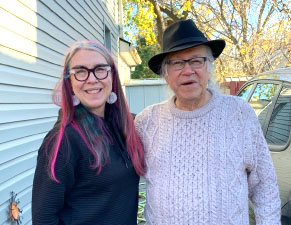
And this journey couldn’t even have begun without Rene Meshake. Since his passing in November of 2024, I continue to do my best to honour him and fulfill the vision he helped me see. I miss you every day, nisayenh.

Rene Meshake

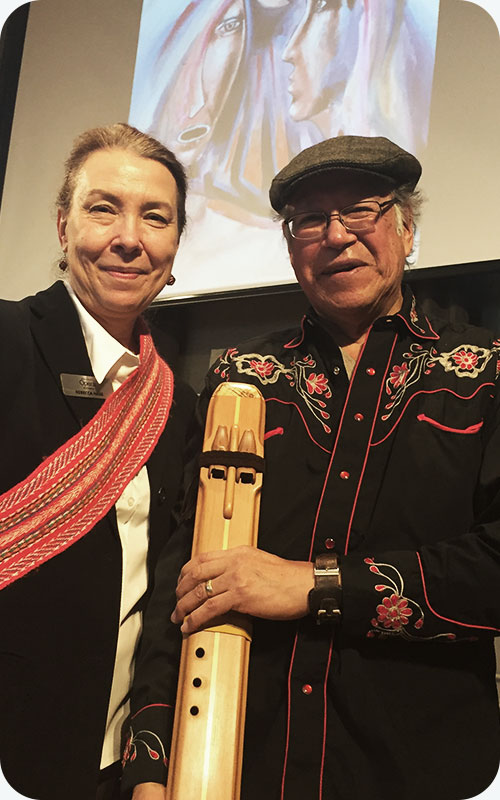
An Ojibwe funky elder, visual and performing artist, award-winning author, storyteller, flute player, new media artist and a Recipient of Queen Elizabeth II’s Diamond Jubilee Medal. He works to fuse Ojibwe and English words into his stories, poetry and spoken word performances, Rene communicates his Ojibwe spiritual heritage to the contemporary world. He was born in the railway town of Nakina in Northwestern Ontario and was raised by his Okomissan grandmother. His education includes: Anishinaabe oral tradition, language, arts and culture. Rene has a diploma in Graphic Design from Sheridan College and a certificate in Creative Writing from the Humber School for Writers. Rene’s body of artwork, stories and his flute improvisations create a strong, expressive, and entertaining presentation for an ever-increasing audience. He also has an active on-line and performing presence as a Funky-Elder and his ‘virtual’ band, The Firebolt Ensemble.

Rene Meshake Website